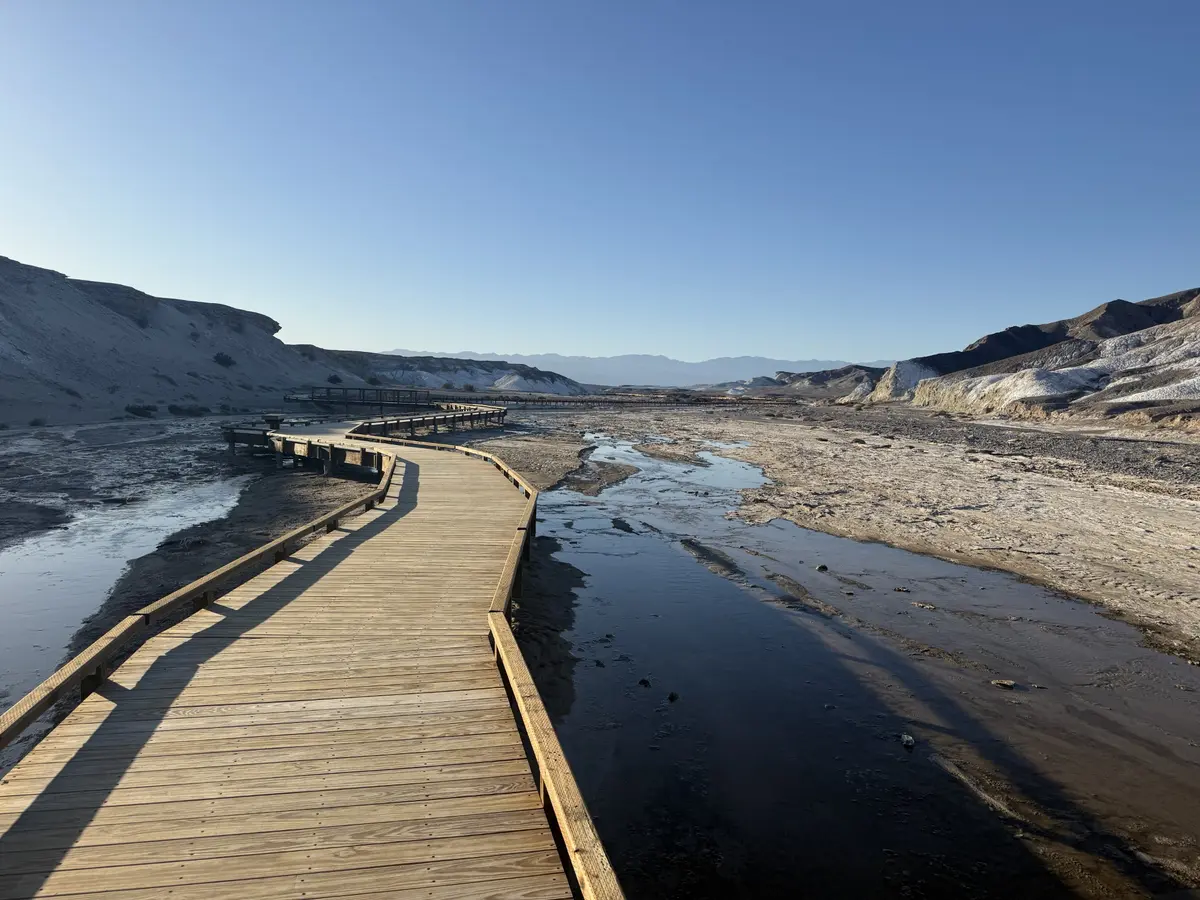
Salt Creek's half-mile boardwalk loop offers something rare in Death Valley: a guaranteed water sighting and a glimpse of life thriving in one of the continent's harshest environments. The trail exists for one primary purpose — to view the endemic Salt Creek pupfish, found nowhere else on Earth, in their shallow desert creek habitat.
Trail Details
- 🏃Activities
- Hiking
- 📊Difficulty
- Easy
- 🔁Trail Type
- loop
- 📏Distance
- 0.5 miles
- 📍Location
- CA
- 🐕Dogs Allowed
- No
- 💵Fee
- Free
Overview
The wooden boardwalk parallels and crosses Salt Creek through a landscape that feels borrowed from another planet. At 200 feet below sea level, this is desert wetland — if such a thing can exist — where a permanent stream creates an oasis in Death Valley's otherwise bone-dry expanse. The trail is entirely flat and wheelchair accessible, making it one of the few truly inclusive experiences in a park that tends toward extremes.
This isn't wilderness hiking. It's more like visiting an outdoor aquarium where the star attraction is a two-inch fish that's been fighting for survival since the Pleistocene. Interpretive signs explain what you're seeing, benches provide rest stops, and the whole experience takes about 30 minutes. The boardwalk exists because the ecosystem is so fragile that a single footprint off the designated path can cause lasting damage.
What to Expect
The trail begins from a gravel parking area and follows a lollipop route that mixes sandy sections with wooden boardwalk. Most of the route stays on the elevated boardwalk, which was recently rebuilt after the August 2022 flash flood carried the original structure over a mile downstream. The new construction includes footings sunk 20 feet deep to handle future flooding.
Salt Creek flows intermittently, typically running from November through May when fed by winter storms. During peak flow in spring, you'll see actual moving water — a startling sight in Death Valley. Even when the creek isn't flowing, standing pools remain year-round, and these are where you'll spot the pupfish. The best viewing happens during spawning season from February through April, when the fish are most active and visible.
The creek environment attracts other desert life, including small mammals, which in turn can attract rattlesnakes. Watch where you step in the sandy sections, though encounters are uncommon.
Tips & Logistics
Access requires driving 1.2 miles on an unpaved but 2WD-friendly road off Highway 190, about 13 miles north of Furnace Creek. The road is well-maintained and suitable for any vehicle, including RVs. A vault toilet sits in the parking area.
Spring brings the ideal conditions: flowing water, active pupfish, and tolerable temperatures. Summer visits are possible but less rewarding, as the creek may be reduced to isolated pools and the heat can be punishing even on a short walk. There's no shade anywhere on the trail.
The standard Death Valley park entry fee applies: $30 for a seven-day vehicle pass or $55 for an annual Death Valley pass. Cell service is essentially nonexistent.
Bring water, even for this brief walk. The desert sun reflects off the light-colored ground and can be deceptively intense. Early morning visits tend to be cooler and often offer better wildlife viewing. Pets aren't allowed on any Death Valley trails, even if carried.
The trail serves a specific purpose — pupfish viewing — and delivers on that promise when conditions align. It's not a hiking destination in the traditional sense, but rather a rare opportunity to witness evolutionary resilience in action. The fish you're looking at have been adapting to this exact spot for thousands of years, making them arguably Death Valley's most successful long-term residents.