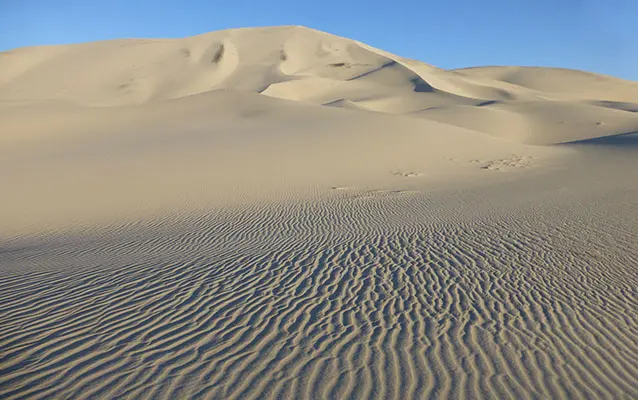
A cross-country trek to one of Death Valley's most remote dune fields, where shifting sands pile against the Panamint Range in near-complete isolation. The route follows no trail beyond the first half-mile, requiring navigation skills and a tolerance for deep sand as you traverse desert flats to reach dunes that rise like golden pyramids from the valley floor.
Trail Details
- 🏃Activities
- Hiking
- 📊Difficulty
- Moderate
- 🔁Trail Type
- out and back
- 📏Distance
- 7 miles
- ⬆️Elevation Gain
- 1,028 ft
- 📍Location
- CA
- 🐕Dogs Allowed
- No
- 💵Fee
- Free
Overview
This is Death Valley backcountry hiking in its purest form: no trail signs, no maintained path, just you and the desert. The Panamint Dunes sit in the western reaches of the valley, accessible only by rough dirt roads and cross-country navigation. Unlike the more famous Mesquite Flat Dunes near Stovepipe Wells, these dunes see few visitors, partly due to the access requirements and partly because most people underestimate what "no trail" actually means.
The experience splits into two distinct phases. The first three miles cross typical Death Valley terrain — alluvial fans, scattered desert pavement, and low washes. The elevation gain is gradual here, building toward the dune field. Once you reach the base of the dunes, the character changes completely. Deep sand replaces firm ground, and every step becomes deliberate as you climb the faces of individual dunes.
What to Expect
The route starts from a parking area at the end of Lake Hill Road, an unmarked dirt track that branches west from Highway 190. The road itself is five miles of punishment for your vehicle's suspension — high clearance is not optional here. From the trailhead, a faint path leads roughly half a mile before disappearing entirely into the desert floor.
Navigation becomes your responsibility from that point forward. The dunes remain visible across the valley, providing a clear destination, but the terrain between is uneven and occasionally rocky. Washes and low ridges create natural corridors, but there's no single "correct" route. GPS helps, but terrain reading matters more.
The final approach to the dunes marks the beginning of the real work. Sand gives way underfoot with every step, turning what looks like gentle slopes into legitimate climbs. Four separate dune ridges offer different perspectives and challenges, each requiring commitment to reach the crest.
Temperature management becomes critical here. The sand reflects and holds heat differently than the surrounding desert, creating localized hot zones even in cooler seasons. Summer temperatures above 115°F make this hike inadvisable from roughly May through September.
Tips & Logistics
Plan this hike between November and March when temperatures stay manageable. Even in winter, start early to avoid afternoon heat buildup in the dunes themselves.
Water planning requires extra consideration. No sources exist along the route, and the sand sections demand more hydration than typical desert hiking. Pack more than your usual calculation suggests.
Navigation tools matter more than on most Death Valley routes. The terrain offers fewer obvious landmarks than canyon hikes, and the cross-country section can be disorienting on the return trip. A GPS device or phone with downloaded maps provides backup when terrain features start looking similar.
Overnight camping requires a free backcountry permit from any Death Valley visitor center. The dunes themselves offer dramatic camping, though wind can be an issue and sand infiltrates everything.
Vehicle requirements are non-negotiable. The access road destroys low-clearance cars, and getting stuck five miles from pavement in Death Valley is not a position you want to find yourself in. Four-wheel drive isn't required, but high clearance absolutely is.
The nearest facilities are at Panamint Springs, about nine miles east on Highway 190. Gas, water, and restrooms are available there, but nothing exists closer to the trailhead.