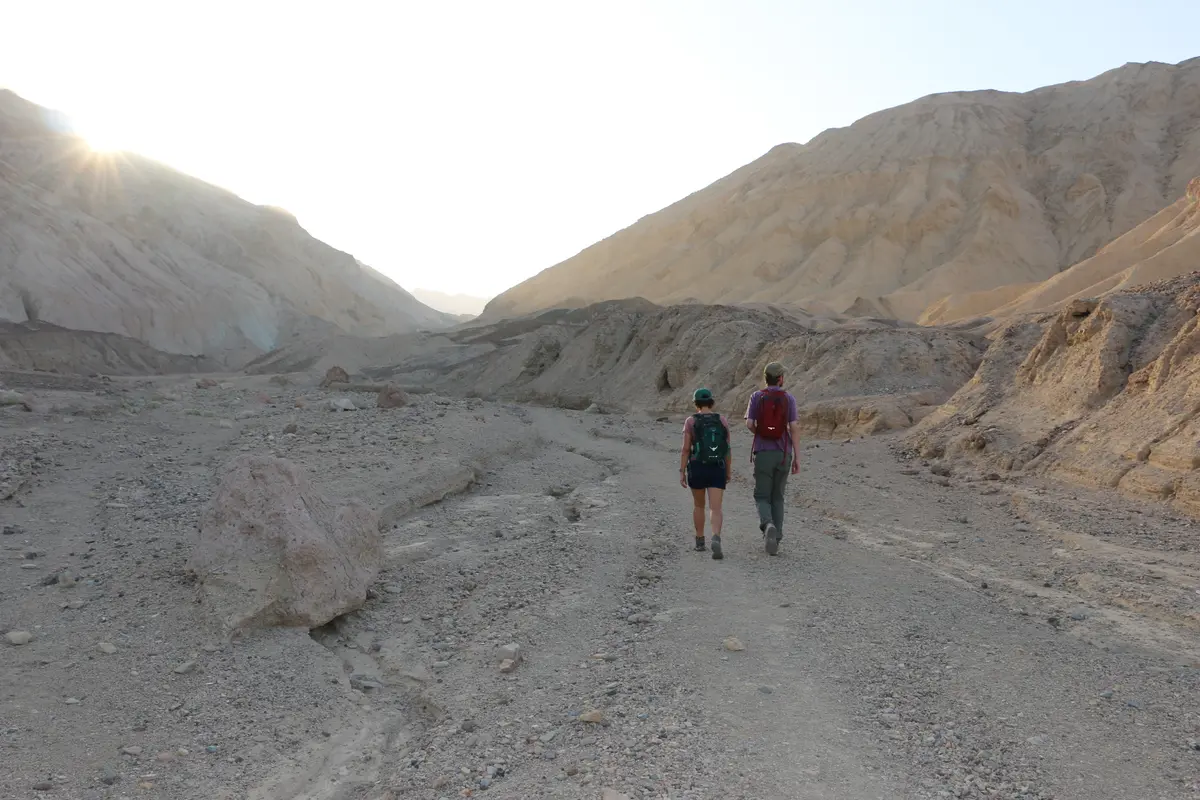
Mosaic Canyon cuts a narrow slot through marble walls polished smooth by flash floods, offering one of Death Valley's most accessible taste of slot canyon hiking. The route follows an active wash where water has carved and sculpted the rock into flowing, organic forms that feel more like walking through sculpture than wilderness.
Trail Details
- 🏃Activities
- Hiking
- 📊Difficulty
- Moderate
- 🔁Trail Type
- out and back
- 📏Distance
- 4 miles
- ⬆️Elevation Gain
- 1,200 ft
- 📍Location
- CA
- 🐕Dogs Allowed
- No
- 💵Fee
- Free
Overview
This is Death Valley's introductory slot canyon — dramatic enough to feel adventurous, short enough to manage in a morning. The first mile lures you in with easy walking through increasingly narrow walls of banded marble. Then the canyon demands payment: a boulder jam that requires actual climbing and scrambling to continue. Most hikers turn around here, having gotten their fill of the sculpted walls and narrow passages.
The geology is the star. These aren't the red rock slot canyons of southern Utah. Mosaic Canyon cuts through marble and metamorphic rock, creating walls that flash from cream to gray to pink depending on the light. Flash floods have polished the stone to a glassy smoothness in places, while elsewhere the rock shows the twisted, folded layers that give the canyon its name.
What to Expect
The canyon walls close in within the first quarter-mile, and from there you're committed to following the wash bottom. There's no trail in the conventional sense — you're walking on stone, sand, and occasional gravel deposits left by the last flood. The going is easy initially, with plenty of room to maneuver around small obstacles.
At roughly 1.3 miles, you hit the boulder jam that separates the casual hikers from the committed ones. This isn't technical rock climbing, but it requires using your hands and finding footholds to work your way up and over house-sized chunks of rock. The scrambling continues intermittently from here, with the canyon alternately opening and pinching shut.
The route ends at a 25-foot dryfall in a dramatic amphitheater. This vertical wall marks the absolute terminus — there's no way around or over it without ropes and serious rock climbing skills. Most people who push past the boulder jam make it this far, giving them a solid 4-mile round trip with 1,200 feet of elevation gain.
Tips & Logistics
The access road is the first filter. Mosaic Canyon Road runs 2.3 miles of well-maintained dirt from Highway 190 to the trailhead parking area. Most cars can handle it if driven carefully, but buses and large RVs should skip this one. The parking area is large and gravel — a rarity in Death Valley.
Weather timing is critical. Summer hiking here borders on dangerous, with the NPS specifically advising against hiking after 10 AM during the hot months. The canyon offers virtually no shade except for the narrow walls themselves. November through March provides the most comfortable conditions, though even then, start early or time your hike for late afternoon light.
Flash flood risk is real and non-negotiable. Don't enter if there's any chance of rain anywhere in the drainage, which extends far beyond what you can see from the trailhead. The smooth, polished walls are testament to the power of water moving through this confined space.
Water is non-negotiable — bring more than you think you need. The nearest restroom is back at Stovepipe Wells Village. No permits required for day hiking, but the park entry fee applies. Dogs aren't allowed on any Death Valley trails, even if carried.
The boulder jam at 1.3 miles provides a natural decision point. Families with young kids or anyone uncomfortable with scrambling can easily turn around here and still experience the best of what Mosaic Canyon offers. Those who continue will earn their views, but the character of the canyon doesn't change dramatically beyond the jam — just more of the same polished marble and narrow passages.