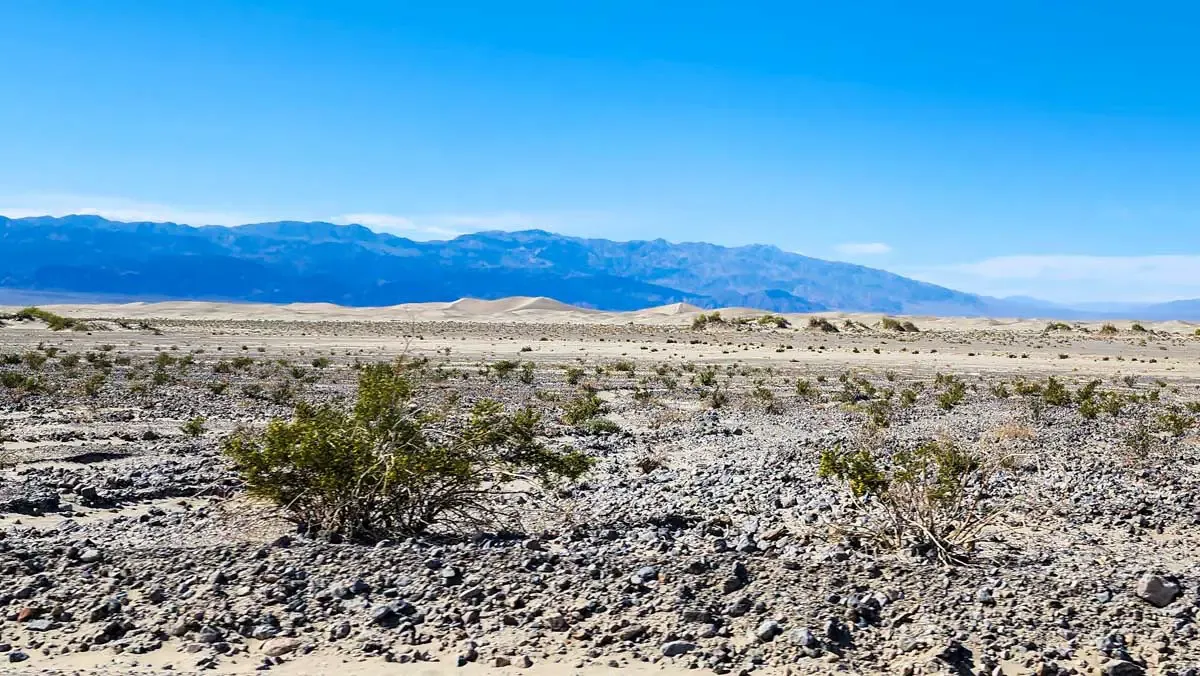
The biggest pile of sand in Death Valley sits right next to Highway 190, which makes it both the park's most accessible dune field and its most crowded. But step beyond the first ridge and the crowds thin out fast across fourteen square miles of shifting sand. The walk to the tallest dune is straightforward enough for families, yet the unmarked terrain and ankle-deep sand make it more of a workout than the modest distance suggests.
Trail Details
- 🏃Activities
- Hiking
- 📊Difficulty
- Easy
- 🔁Trail Type
- out and back
- 📏Distance
- 2 miles
- ⬆️Elevation Gain
- 185 ft
- 📍Location
- CA
- 🐕Dogs Allowed
- No
- 💵Fee
- Free
Overview
Mesquite Flat offers Death Valley's most user-friendly introduction to desert sand hiking. The dunes rise 100 feet above the valley floor, formed by sand eroding from the mountains to the north and trapped by the southern ranges. Unlike the park's remote backcountry, this area requires no navigation skills or high-clearance vehicle — just follow Highway 190 to the paved parking lot two miles before Stovepipe Wells.
The experience splits into two distinct zones. Most visitors cluster on the lower dunes visible from the parking area, taking photos and turning back within a half-mile. Those who push deeper into the dune field find more solitude and better views, though the walking gets progressively more demanding as the sand deepens.
No official trails exist here. The route to the highest dune is simply "that way," across open sand that shifts with every windstorm. Animal tracks from kangaroo rats and the occasional sidewinder rattlesnake provide the only consistent markings, most visible at sunrise before human footprints erase them.
What to Expect
The walk begins on a hard-packed surface near the parking area, then transitions to increasingly soft sand as you move deeper into the dunes. The initial quarter-mile feels like a stroll. After that, each step sinks several inches, turning a casual walk into a legitimate leg workout.
The tallest dune sits roughly a mile from the parking area, though distances become deceptive in the featureless sand. What looks close can take twice as long to reach, especially as you navigate around the steeper faces and find the most walkable routes up each ridge.
Wind patterns determine the dune shapes and walking conditions. Fresh wind creates firm, rippled surfaces that provide good footing. Calm periods leave the sand looser and more challenging. The dunes shift constantly, so don't expect to follow anyone else's footprints from previous days.
The area offers zero shade and complete sun exposure. The contrast between air temperature and ground temperature can be extreme — sand surface temperatures regularly exceed 140°F even when air temperatures are merely hot by Death Valley standards.
Tips & Logistics
Visit between November and April when temperatures remain manageable. Summer hiking here borders on dangerous, with ground temperatures hot enough to cause burns through thin-soled shoes.
Early morning provides the best conditions. Sunrise offers cool temperatures, firm sand from overnight cooling, and fresh animal tracks before other visitors arrive. Late afternoon works too, but the sand retains heat longer than you'd expect.
The parking lot includes vault toilets and spaces for RVs, but no water. Fill up at Stovepipe Wells or Furnace Creek before arriving. Bring more water than you think you need — walking in sand is dehydrating work.
Wear closed-toe shoes with thick soles. Sand gets everywhere, including inside boots, so consider gaiters or at least plan on emptying shoes frequently. Sunglasses and sun protection are essential given the complete lack of shade and the sand's reflective surface.
Dogs are prohibited throughout Death Valley's dune areas. Watch your step to avoid disturbing animal burrows, and stick to established parking areas rather than creating new ones — the desert recovers slowly from vehicle damage.