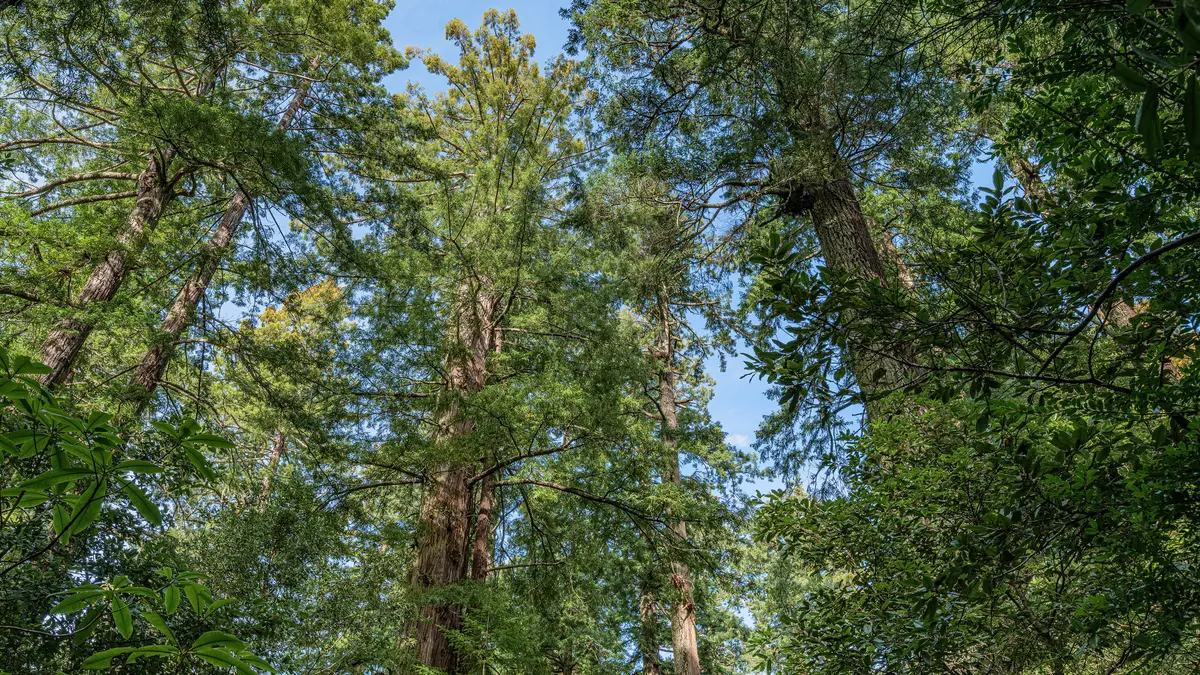
This gentle loop through the Lady Bird Johnson Grove offers something most redwood trails don't: a clear view of what logging did to this landscape and what time might heal. At 1,000 feet above the coast, the grove sits in a transition zone where you can see both ancient forest and the stubbled hillsides where clearcuts once ran to the highway.
Trail Details
- 🏃Activities
- Hiking
- 🔁Trail Type
- out and back
- 📏Distance
- 1.5 miles
- 📍Location
- CA
- 🐕Dogs Allowed
- No
- 💵Fee
- Free
Overview
The Lady Bird Johnson Grove sits on a ridge above the coastal fog line, where the extra elevation brings more rain and creates conditions that make these redwoods appear less vibrant red than their sea-level cousins. It's a short walk — 1.5 miles with minimal elevation gain — but the setting tells a story that spans centuries. Ancient trees share the ridge with massive stumps from the 1960s, when this hillside was stripped bare except for the giants too big to cut economically.
The trail itself is wide and well-maintained, built to accommodate visitors who might not tackle the park's more demanding routes. But accessibility comes with restrictions: no dogs, and Bald Hills Road's narrow, winding approach means RVs and trailers can't make the trip up from Highway 101.
What to Expect
Stop #8, the "Redwood Resurrection" interpretive point, sits at the heart of what makes this trail worth your time. Here you're standing in a transition zone where logged and unlogged forest meet, and the contrast is stark. The absence of tall trees in the distance marks where clear-cutting extended from this spot all the way to the highway. In the early 1960s, this hillside was essentially moonscape — nothing but stumps and bare ground.
The environmental reality is more complex than simple before-and-after. Trees at the forest edge, suddenly exposed after a century in the protection of the grove, face high winds, salt air, and direct summer heat they were never adapted to handle. The tops of the tallest trees wither and die; others collapse entirely. The forest you're walking through is actively changing as it adjusts to new conditions.
Natural recovery is slow but visible. Redwood burls send up new sprouts from their ancestor's stumps, while fir and hemlock seeds drift in from intact forest nearby. Given enough time — decades, not years — the clearcut will fill with ferns and shrubs, then gradually with new trees. Whether those trees will ever reach old-growth stature is a question for future centuries.
Tips & Logistics
The 3-mile drive up Bald Hills Road from Highway 101 is half the adventure. The road is genuinely narrow with few pullouts, and the park service isn't kidding about the trailer restrictions. If you're driving anything larger than a standard passenger vehicle, think twice. There's one van-accessible parking space at the trailhead, but the lot fills on busy summer weekends.
The trail includes a hikers' bridge that's not officially wheelchair accessible due to its slope, though visitors with all-terrain wheelchairs have made it work. The path itself is typically 6 feet wide, alternating between natural dirt and wooden bridging.
No permits or fees required, and the elevation means you're usually above the coastal fog that can sock in lower trails. Early morning offers the best light filtering through the canopy, but any time works for this short loop. Bring layers — the ridge can be 10-15 degrees cooler than the coast, and conditions change fast when fog rolls up from below.