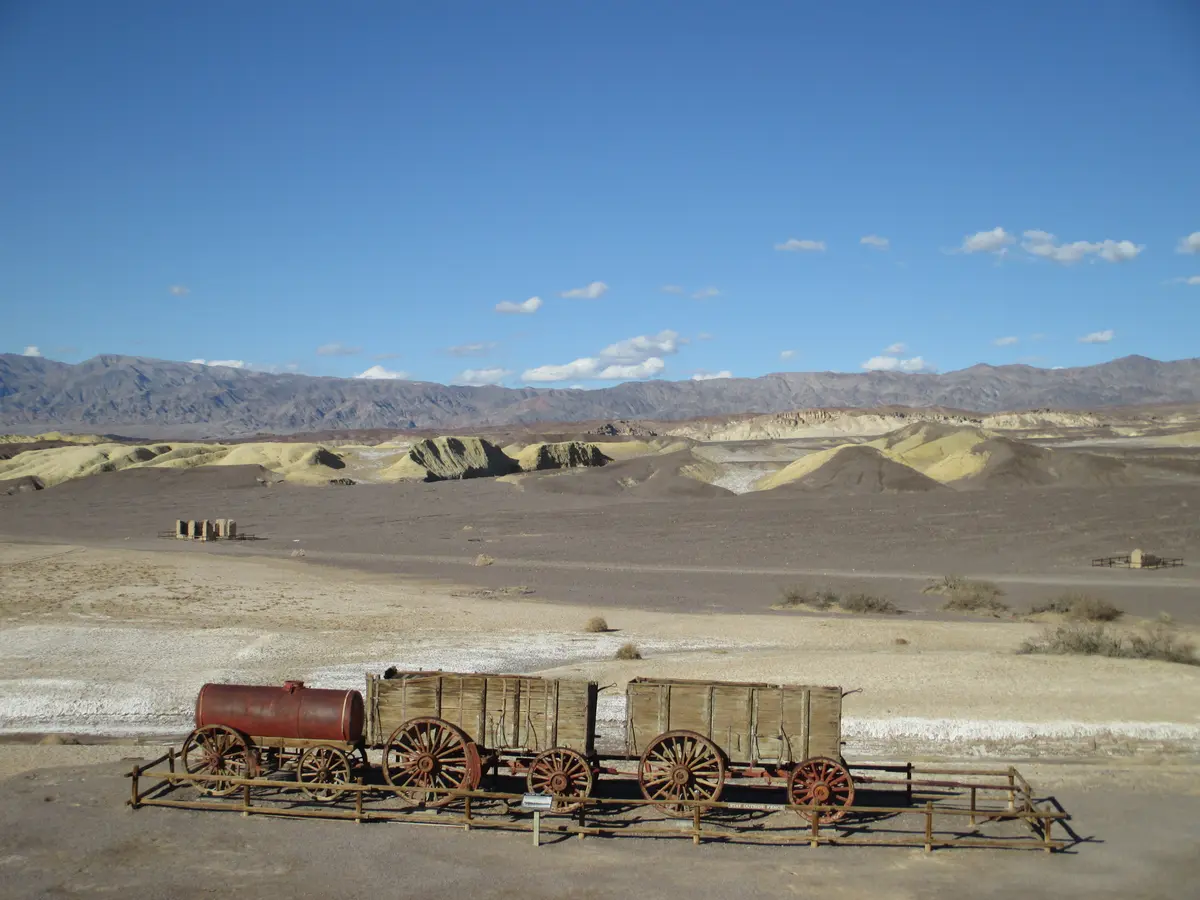
This quarter-mile paved loop delivers maximum historical payoff for minimal effort. The Harmony Borax Works Trail circles the adobe ruins and machinery remnants of an 1880s borax operation, complete with an original twenty-mule team wagon that once hauled loads 165 miles to Mojave.
Trail Details
- 🏃Activities
- Hiking
- 📊Difficulty
- Easy
- 🔁Trail Type
- loop
- 📏Distance
- 0.4 miles
- ⬆️Elevation Gain
- 50 ft
- 📍Location
- CA
- 🐕Dogs Allowed
- No
- 💵Fee
- Free
Overview
The trail puts you inside what remains of a short-lived but significant chapter in Death Valley's mining history. Harmony Borax Works operated for just four years in the 1880s, but it established the twenty-mule team as an enduring symbol of the American West. The paved loop winds through the actual ruins where Chinese laborers processed borax from the valley floor, past the adobe walls where workers lived, and alongside the massive wagon that made it all economically viable.
The experience is more museum than hike. Interpretive panels explain the borax extraction process and the logistics of moving product across 165 miles of desert before the railroad arrived. The contrast is stark: this industrial operation flourished briefly in what's now one of America's most remote national parks.
What to Expect
The pavement is mostly solid but shows its age in places—expect some cracking and crumbling sections that don't affect accessibility. The loop gains about 50 feet as it curves around the site, nothing more challenging than a grocery store parking lot.
The twenty-mule team wagon sits near the trailhead and commands attention. These rigs stretched 100 feet from the lead mules to the rear water trailer and could haul 20 tons of borax. Standing next to one makes the engineering achievement more tangible than any interpretive sign.
Adobe ruins dot the hillside, remnants of the Chinese quarters and other buildings. The structures are fenced off, but you get close enough to appreciate the construction methods and imagine daily life at this isolated outpost. The borax processing area shows traces of the original machinery, though most equipment was salvaged long ago.
Views extend across the valley floor toward the Funeral Mountains. The scale helps explain why the twenty-mule teams were necessary—and why Harmony closed once the railroad reached other borax deposits that didn't require such heroic transportation.
Tips & Logistics
Summer hiking ends at 10 AM. This isn't negotiable advice—it's when the pavement becomes painful to walk on and shade disappears entirely. Winter and spring offer comfortable conditions all day.
Park at the paved lot one mile west of Furnace Creek on Highway 190. The lot accommodates RVs and buses, with designated accessible spaces. No restrooms here; use the facilities at Furnace Creek Visitor Center before driving over.
The trail works for wheelchairs, strollers, and anyone with mobility limitations. Fifteen minutes covers the loop at a leisurely pace, though history buffs often spend longer reading the interpretive materials and examining the wagon details.
Water and shade are nonexistent beyond what you bring. The park's standard entrance fee applies. Pets stay in the car—they're prohibited on all Death Valley trails, even if carried.
This pairs well with other Furnace Creek area stops like Badwater Basin or the Borax Museum, making it easy to knock out several attractions in a morning before the heat takes over. The historical significance and minimal physical demand make it particularly valuable for visitors who want to engage with Death Valley's human history without committing to serious desert hiking.