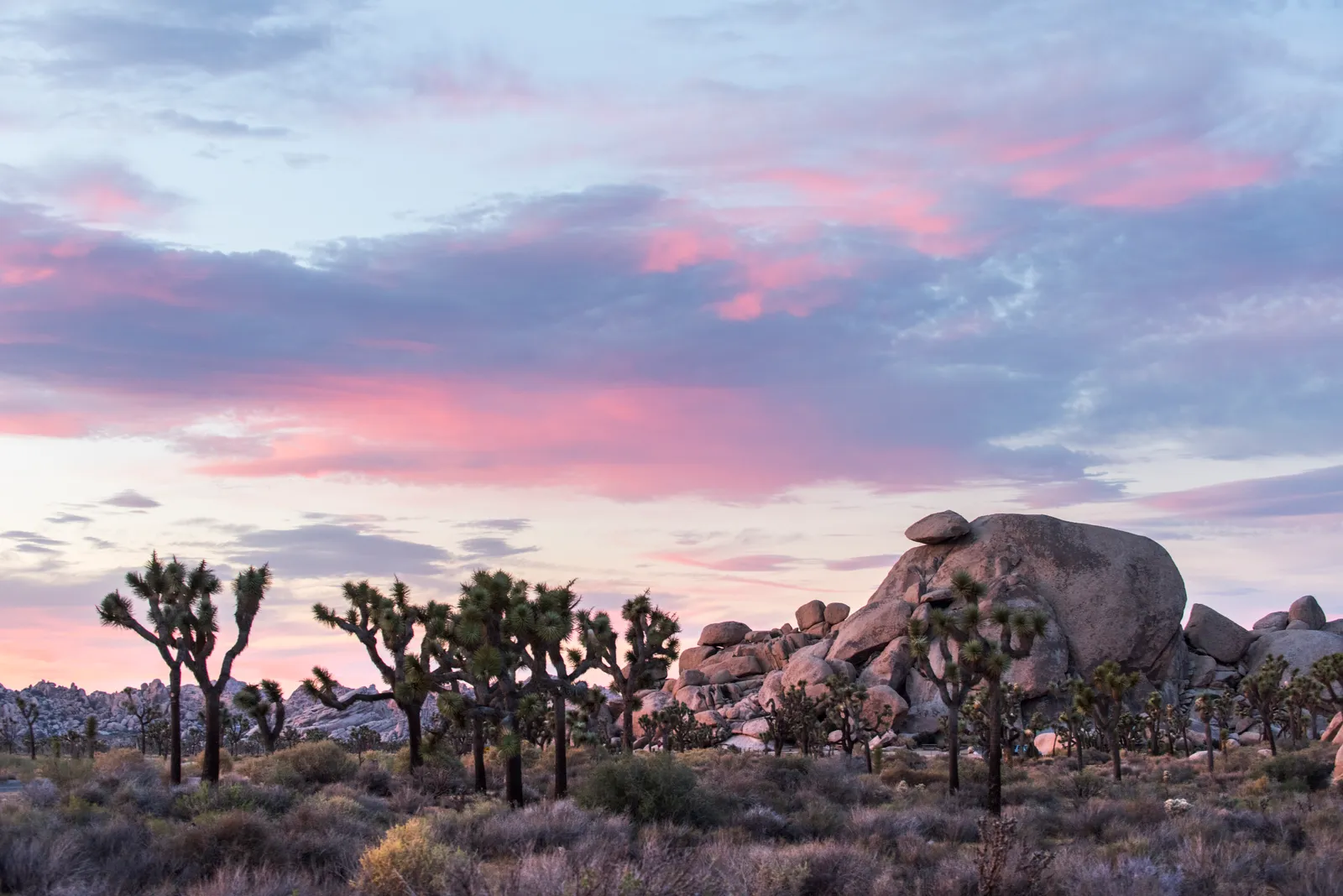
Cap Rock's 0.4-mile loop delivers Joshua Tree's signature landscape without the commitment. The trail winds between monzogranite boulders and through Joshua tree woodland, ending where it started in about 15 minutes — perfect for first-time visitors getting their desert legs or anyone wanting a quick stretch between longer drives through the park.
Trail Details
- 🏃Activities
- Hiking
- 📊Difficulty
- Easy
- 🔁Trail Type
- loop
- 📏Distance
- 0.4 miles
- 🪨Surface
- dirt
- 🌤️Best Seasons
- december, january, february, march, april, may, june, july, august, september, october, november
- 📍Location
- CA
- 🐕Dogs Allowed
- No
- 💵Fee
- Free
Overview
This is Joshua Tree distilled to its essence: the namesake trees rising from sandy washes, house-sized granite boulders balanced in impossible arrangements, and the particular quality of Mojave Desert light that makes everything look like a film set. The trail takes its name from the caprock boulder perched atop the main formation — a textbook example of the geological forces that shaped this landscape.
The route stays on packed dirt with only 22 feet of elevation gain, making it one of the park's most accessible options. You'll walk clockwise through classic Joshua tree woodland, weaving between granite domes that offer natural windbreaks and photo opportunities. The trail delivers the full Joshua Tree experience in miniature: the alien silhouettes of the trees, the sculptural rock formations, and that sense of walking through a landscape that belongs on another planet.
What to Expect
The trailhead sits on the eastern side of the parking lot, where interpretive signs introduce you to the Mojave Desert ecosystem. The path immediately enters Joshua tree woodland — not the sparse, struggling trees you might expect, but a relatively dense stand of mature specimens mixed with Mojave yuccas and the occasional pinyon pine.
Granite dominates the scenery. These monzogranite formations weathered into their current shapes over millions of years, leaving behind the balanced rocks and natural sculptures that define the park. The trail weaves between and sometimes over these formations, with occasional mild inclines where the path climbs over rock slabs. Benches appear along the route for rest stops, though you'll likely complete the circuit before needing them.
The loop brings you close enough to the signature Cap Rock formation to appreciate the physics of that precariously balanced boulder, then continues through more Joshua tree groves before completing the circuit back at the parking area. Without significant elevation change, the experience stays consistent throughout — no dramatic vistas or challenging terrain, just steady immersion in this particular desert ecosystem.
Tips & Logistics
Cap Rock sits at the intersection of Park Boulevard and Keys View Road, making it a natural stop on the standard Joshua Tree touring circuit. Turn off Park Boulevard onto Keys View Road and drive 0.2 miles to reach the trailhead. The parking lot holds over two dozen vehicles, but Keys View Road frequently closes when parking fills up — arrive early, especially on weekends and during peak season.
Morning visits offer the best parking availability and more comfortable temperatures. The trail provides minimal shade, so sun protection matters even on short walks. Water isn't critical for such a brief hike, but desert conditions can be deceptive — bring some anyway, especially if you're not acclimated to the dry air.
The packed dirt surface works for most visitors, including those using wheelchairs, though the occasional rock slab might present challenges. Pets aren't allowed on park trails, but service animals are welcome.
Consider Cap Rock as part of a larger itinerary rather than a standalone destination. The nearby picnic area includes grills and restrooms, making it a logical lunch stop. After dark, the parking lot serves as one of four designated stargazing areas in the park, taking advantage of the minimal light pollution and clear desert skies.
The trail works year-round, though summer afternoons can be punishing even for such a short walk. Winter and spring offer the most comfortable conditions, with the added possibility of desert wildflowers if winter rains cooperate.