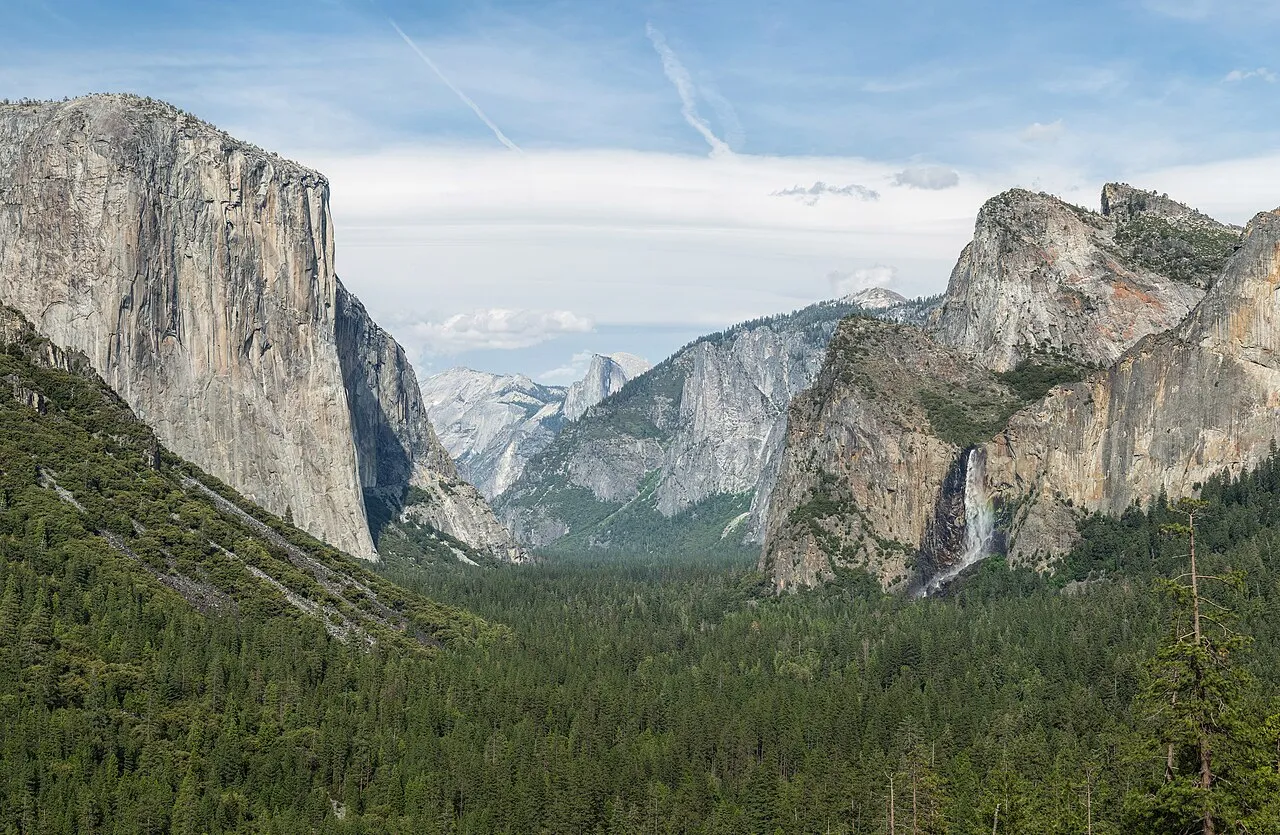
Yosemite National Park
Sierra Nevada · CA
Yosemite National Park covers 760,000 acres of the central Sierra Nevada, from the glacier-carved Valley floor at 4,000 feet to granite peaks above 13,000. Most people know it for Half Dome, El Capitan, and the waterfalls, but over 94% of the park is designated wilderness with 800 miles of trail. Whether you're car-camping in the Valley and day-hiking to waterfalls or planning a week-long backpacking route through the high country, Yosemite rewards anyone willing to lace up boots and go.
Details
- 🏞️Type
- National Park
- 🏛️Managed by
- National Park Service
- 📍State
- CA
- 🗺️Address
- 9035 Village Dr, Yosemite Valley, Mariposa, CA, 95389
- 📞Phone
- (209) 372-0200
- 🕐Hours
- Open 24 hours year-round. Some roads close seasonally.
- 📅Established
- 1890
- 📐Area
- 759,620 acres
- 💵Entrance Fee
- $35 / vehicle
- 🐾Pets Allowed
- Yes
- ♿Accessibility
- limited
- 🌤️Best Seasons
- spring, summer, fall
- 🥾Activities
- hiking, rock climbing, camping, backpacking, fishing, photography, stargazing, swimming, horseback riding, cross-country skiing
- 📡GPS
- 37.86510, -119.53830
The Place
Yosemite's geology is the show. The Valley is a mile-wide, glacier-carved trench walled by sheer granite — El Capitan on one side, Cathedral Rocks and Half Dome on the other, with waterfalls pouring off the rim in spring. It's one of the most concentrated collections of vertical rock on Earth, and even after millions of photographs, seeing it in person still recalibrates your sense of scale.
But the Valley is a small fraction of the park. Above the rim, the landscape opens into the Sierra high country: the Cathedral Range's sharp spires, Tuolumne Meadows' polished granite domes, the headwaters of the Merced and Tuolumne rivers, and hundreds of alpine lakes tucked into cirque basins. Elevations range from 2,000 feet at the western boundary to 13,114 feet at Mount Lyell. The lower elevations are oak woodland and mixed conifer; above 9,000 feet you're in subalpine granite country dotted with whitebark pine and mountain hemlock.
The range of experiences here is wide. You can pitch a tent in a developed campground, walk ten minutes to a waterfall, and be back for dinner. Or you can spend a week traversing passes above 10,000 feet and not see another person for days. Both are real Yosemite.
Getting There & Getting In
Yosemite has five entrances, but your choice depends on what you're after. The South Entrance (Highway 41 from Fresno) and the Arch Rock Entrance (Highway 140 from Merced) are the primary routes to the Valley. Highway 140 follows the Merced River canyon and is generally the easiest drive. Highway 41 connects to Glacier Point Road and the Mariposa Grove of giant sequoias.
For the high country, you need Tioga Road (Highway 120). The Big Oak Flat Entrance on the west side and Tioga Pass on the east side connect to this road, which runs through Tuolumne Meadows at 8,600 feet. Tioga Road is the critical variable for planning: it closes with the first significant snow in late October or November and doesn't reopen until late May to late June, depending on snowpack. Until it opens, the entire high country is inaccessible by car.
Gateway towns: Mariposa and El Portal on the south/west side; Groveland on Highway 120 West; Lee Vining on the east side of Tioga Pass. All have gas, groceries, and lodging. Lee Vining is smallest and most seasonal but puts you closest to Tuolumne.
Cell service works in parts of the Valley and near Crane Flat. Along Tioga Road it's spotty. In the backcountry, expect nothing. Download maps before you leave pavement.
When to Go
Yosemite Valley is accessible year-round, and every season has something going for it. The high country is a different story — gated by Tioga Road and snowpack.
Spring (April–June): The waterfalls are at peak flow from snowmelt. Yosemite Falls, Bridalveil Fall, and the Mist Trail are at their most dramatic. The Valley can be crowded on weekends but the spectacle is worth it. Higher-elevation trails may still be snow-covered into June. Tioga Road is usually still closed.
Summer (July–August): The full park is open. Tuolumne Meadows and high-country trails are accessible. This is prime backpacking season — passes are clear, wildflowers peak in the meadows, and the days are long. The Valley is hot (90s°F) and crowded. Afternoon thunderstorms build regularly in the high country, usually clearing by evening.
Fall (September–October): The sweet spot for many visitors. Crowds thin after Labor Day, the light turns golden, the air is dry and clear. High-country trails are still in good shape through September. Water sources begin drying up at lower elevations. October brings the first possibility of Tioga Road closure — check conditions.
Winter (November–March): The Valley is quiet and often dusted with snow. Yosemite Falls may be frozen. Badger Pass ski area operates for downhill and cross-country skiing. Tioga Road and Glacier Point Road are closed. Valley campgrounds remain partially open. It's a different park — uncrowded, cold, and beautiful in its own way.
Permits & Regulations
Day hiking: No permit required for day hikes except Half Dome. The Half Dome cables are up from late May through Columbus Day, and a separate permit lottery is held in March at recreation.gov. 300 hikers per day. Apply for midweek dates if you want better odds.
Wilderness permits (overnight): Every overnight backcountry trip requires a permit tied to a specific trailhead and date. The system is quota-based and moderately competitive during peak season.
60% of each trailhead's daily quota goes through weekly lotteries on recreation.gov, opening 24 weeks in advance (lottery runs Sunday through Saturday). Unclaimed lottery permits release on Fridays at 9 AM PT. The remaining 40% drops at 7 AM PT seven days before the trip date. Cost is $10 per reservation plus $5 per person.
Walk-up availability: no formal quota is held, but unclaimed reservations release at 11 AM on the start date. Midweek at less popular trailheads, same-day permits are realistic. Happy Isles on a July Saturday — don't count on it.
JMT southbound permits (starting at Happy Isles) are the hardest to get in the park. A separate rolling lottery through the Yosemite Conservancy handles Donohue Pass exit quota. About 97% of peak-season applications are denied. Success rates improve after mid-August.
Bear canisters are required for all overnight wilderness trips, park-wide. No exceptions, no bear hangs. Canisters can be rented at wilderness permit stations.
Campfires are prohibited above 9,600 feet in the wilderness. Below that, fires are allowed in existing rings only and may be further restricted in dry conditions.
Entrance fee: $35 per vehicle.
Hiking & Routes
Yosemite's trail system runs from paved Valley walks to serious high-country traverses. A sampling across the spectrum:
Mist Trail to Vernal and Nevada Falls: 5.4 miles round-trip to the top of Nevada Fall, 2,000 feet of gain. Starts from Happy Isles in the Valley. One of the most popular hikes in the park for good reason — you climb directly alongside two major waterfalls. Steep granite staircase, heavy spray in spring (bring a rain layer). Doable for fit beginners; the section to Vernal Fall (2.4 miles RT) is a shorter option.
Half Dome: 14–16 miles round-trip from the Valley, 4,800 feet of gain. A full-day commitment. The cables section at the top is the crux — exposed, steep, and requires a permit. Not for anyone uncomfortable with heights. Gloves help.
Cathedral Lakes: 7 miles round-trip from Tioga Road, 1,000 feet of gain. One of the best day hikes in the high country — or a short overnight. Upper and Lower Cathedral Lakes sit beneath the spires of Cathedral Peak at about 9,500 feet. Moderate difficulty, high reward.
Vogelsang–Lyell Canyon Loop: 25 miles, 3 days, from Tuolumne Meadows. The classic Yosemite high-country backpacking introduction. Crosses Vogelsang Pass at 10,700 feet, drops to Merced Lake, returns via Lyell Canyon along the JMT. Well-maintained trail, moderate difficulty for experienced hikers.
Grand Canyon of the Tuolumne: 30 miles point-to-point, 3–4 days, Tuolumne Meadows to Hetch Hetchy via Glen Aulin and Waterwheel Falls. A 4,000-foot descent through a dramatic canyon with cascading falls and increasing solitude the deeper you go. Trail gets rough below Glen Aulin.
Yosemite High Route (Skurka): 94 miles, 7–10 days, mostly off-trail. Class 2–3 terrain, significant route-finding, no maintained path for long stretches. For experienced off-trail travelers only.
Camping
Valley campgrounds: Upper Pines, Lower Pines, and North Pines are the Valley's reservable campgrounds — wooded sites along the Merced River, walking distance to trailheads and the Village. They book months ahead on recreation.gov. Camp 4 (walk-in, first-come) is the legendary climber's camp — $6/person, no reservations, fills by dawn in summer.
Tuolumne Meadows Campground: 304 sites at 8,600 feet, open when Tioga Road is open (typically July–September). Reservable and first-come sites. Cooler, quieter, and a better base for high-country hiking than the Valley.
Hodgdon Meadow and Crane Flat: Less central but also less chaotic. Good options if you're arriving from the west and want a base without Valley crowds.
Backcountry camping: With a wilderness permit, you can camp throughout the backcountry. Established camps exist along popular corridors (Merced Lake, Glen Aulin, Sunrise). Off-trail, pick a durable surface 100 feet from water and trail. Bear canisters required everywhere.
Water, Weather & Hazards
Water is plentiful through July from snowmelt-fed streams and lakes. By September, smaller streams at lower elevations dry up — plan camps around reliable sources. Above 9,000 feet, lakes and larger creeks stay reliable into October. Filter everything; Giardia is present throughout the Sierra.
Weather follows Sierra patterns: clear mornings, afternoon cumulus buildup, and scattered thunderstorms from July through September. Lightning is the primary weather hazard on exposed ridges and peaks above treeline. If clouds are building by noon, be off high ground by early afternoon.
Stream crossings are the most serious seasonal hazard in June and early July. Snowmelt-swollen creeks can be waist-deep and fast. The Merced River and Lyell Fork are the most notable. Cross early morning when flows are lowest. Unbuckle your hip belt.
Altitude affects visitors arriving from low elevation. Tuolumne sits at 8,600 feet; passes top 10,000. Spend a night at elevation before pushing hard. Acute mountain sickness is common and usually mild, but it can ruin a trip.
Black bears are smart, habituated, and persistent — especially near popular campsites. The canister requirement exists because Yosemite bears have defeated every other storage method. Keep your canister closed and 20 feet from your sleeping area.
Finding Solitude
The crowds concentrate in the Valley (4 million visitors a year, mostly in summer), along the Mist Trail, and at Tuolumne Meadows. About 10% of the park's trail mileage sees 80% of backcountry use.
Hetch Hetchy: The park's most undervisited region. Only about 1% of visitors make the 40-mile drive from the Valley. Rancheria Falls, Laurel Lake, and the Tiltill Valley area see minimal traffic despite the same granite-and-waterfall landscape.
North boundary: Routes toward Matterhorn Peak, Tilden Lake, and the northern Grand Canyon of the Tuolumne are among the quietest. Longer approaches filter out casual traffic.
Timing: Weekday starts and September dates are the simplest solitude strategy. After Labor Day, the high country empties dramatically while conditions remain good.
Backdoor entries: Coming in from adjacent wilderness — Emigrant, Hoover, Ansel Adams — lets you enter Yosemite from its quieter edges. Permits from adjacent national forests are often easier to get.
In the Valley: Even in summer, trails beyond the first mile or two thin out. The Valley rim trails (North Rim, Pohono Trail) are a fraction as busy as the Valley floor.